

The Fifth Element
In ancient mythology, aether was the fifth element — an invisible substance believed to fill all space. Unlike the physical elements, it was eternal, omnipresent, and fundamental to the structure of the cosmos.
The core idea was simple: space is not empty. Something unseen permeates all of reality, connecting everything in an invisible web of existence.
Tesla's Insight
Nikola Tesla shared this ancient intuition. He rejected the idea of empty space and argued that energy exists everywhere, carried by a subtle medium.
His work on wireless power and resonance was built on the belief that space itself can transmit energy.

Vitalik's Refutal
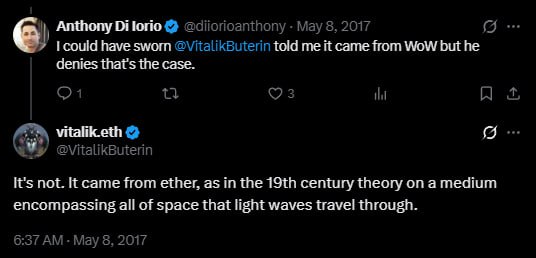
Vitalik refuted claims that Ethereum idea came from WoW. He clarified that it came from 19th century theory on a medium encompassing all of the space that light wave travels through.
Forgotten, Not Disproven
Physics later abandoned the word aether, replacing it with spacetime and mathematical fields. Yet modern science now speaks of vacuum energy and quantum fields — again suggesting that space is active, not void.
Tesla may have been early, but not wrong. The concept persists under different names, in different forms, waiting to be rediscovered by each generation.

Aether Reimagined
Vitalik Buterin named Ethereum after aether to express a similar vision: an invisible, universal layer that supports everything built upon it.
Just as ancient philosophers believed aether permeated all space, Ethereum was designed to be the underlying substrate for decentralized applications — imperceptible yet essential, connecting all parts of the digital ecosystem.
"Different eras. Same idea. Reality runs on an unseen substrate."

The invisible becomes visible. The substrate becomes the platform.
Tokenomics
No buy or sell taxes
LP tokens permanently removed
Fully decentralized
Fixed supply cap